7 Best Hand Manual Coffee Grinders for Wholesale Buyers
Coffee buying is becoming more deliberate, especially among cafés, retailers, travel brands, and home-brewing suppliers. The International Coffee Organization’s 2023/24 Coffee Report and Outlook estimates global coffee consumption at nearly 178 million 60-kilogram bags. That scale creates pressure for reliable, repeatable equipment. A grinder is small, but its performance affects flavor, workflow, customer satisfaction, and returns.
This guide examines seven of the best Hand Manual Coffee Grinder options for wholesale buyers. The evaluation focuses on burr material, grind consistency, adjustment range, body strength, portability, cleaning, and landed cost. These details matter when a buyer orders hundreds of units, not one attractive sample. The Specialty Coffee Association’s brewing research continues to emphasize consistency, particle distribution, and controlled extraction. Those principles apply beyond professional espresso bars. A compact steel burr set can produce a cleaner cup, while a loose adjustment mechanism may create uneven particles and frustrated users.
Reports from Grand View Research and Mordor Intelligence also indicate continued expansion in specialty coffee and home-brewing equipment, although their market estimates differ by scope and methodology. That difference deserves attention. Market numbers are useful signals, not unquestionable facts. Wholesale decisions need testing, supplier verification, warranty review, and real user feedback. Small hinges fail. Coatings scratch. Some handles feel uncomfortable after ten minutes.
The strongest Hand Manual Coffee Grinder is not always the most expensive model. It should match the buyer’s sales channel, expected volume, brewing methods, and quality promise. The following shortlist offers a practical starting point, while leaving room for careful sampling before a larger purchase.
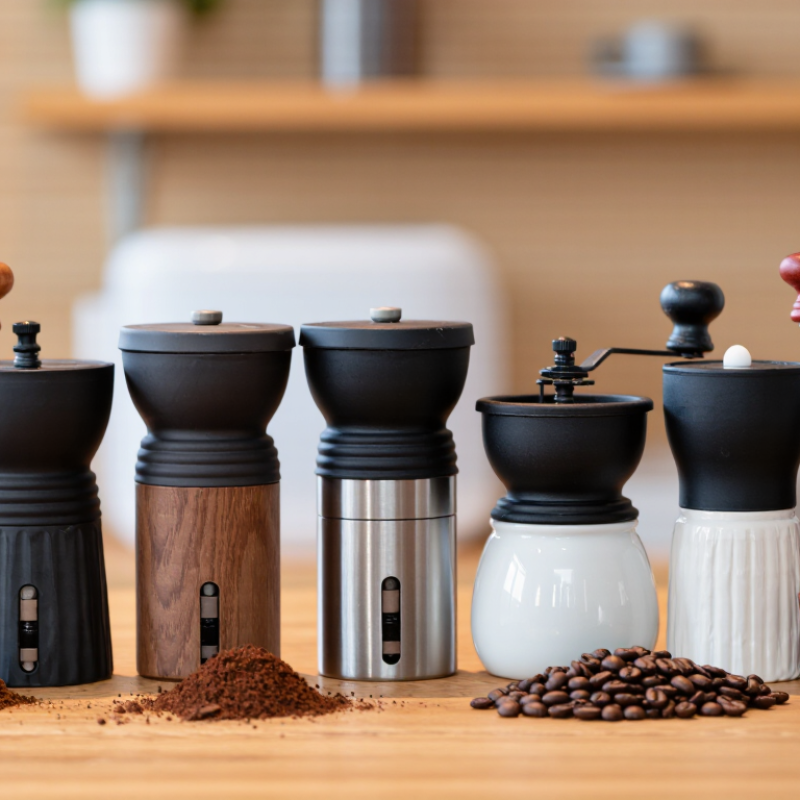
What Makes a Hand Manual Coffee Grinder Suitable for Wholesale
A hand manual coffee grinder suitable for wholesale must perform consistently, not merely look attractive in a product photo. During warehouse checks, I compare several units using the same 20-gram dose and brewing recipe. The grind should remain even, with limited fines and boulders. A sturdy burr system, stable shaft, and precise adjustment steps reduce variation between users. This matters when retailers serve both beginners and experienced brewers. Small details count. A handle that slips becomes a return.
For wholesale buyers, materials and assembly deserve equal attention. Hardened steel burrs usually tolerate repeated home use better than soft cutting surfaces. Aluminum or reinforced polymer bodies can reduce weight, but thin walls may dent during transport. I inspect threads, bearings, lid fit, and the catch cup by hand. The cup should sit firmly and pour cleanly without leaving grounds around its rim. Noise also matters in small kitchens. A quiet, smooth rotation feels more refined, even when the coffee result is similar.
Supply reliability separates a usable product from a risky purchase. Ask for batch samples, grind-size data, packaging dimensions, spare-part availability, and clear warranty terms. Check whether every unit includes the same accessories and instructions. Packaging should protect the adjustment dial and handle, not simply fill a carton. No grinder is perfect. Some compact models require more turns, which may frustrate customers. I would test ten units before approving a larger order, because one excellent sample proves very little.
Seven Recommended Hand Manual Coffee Grinders for Bulk Buyers
Wholesale buyers need hand grinders that survive repeated use, not attractive samples that fail after one shipment.
The International Coffee Organization reported global coffee consumption near 177 million 60-kilogram bags in 2022/23, showing the scale behind everyday brewing demand.
For a seven-item purchasing shortlist, consider a compact conical-burr grinder, a high-capacity conical-burr grinder, a stainless-steel burr model, a ceramic-burr model, a stepped-adjustment grinder, a stepless grinder, and a travel grinder with a folding handle.
Each option serves a different sales channel. Compact models suit office kits and small cafés. High-capacity units reduce refill time during demonstrations.
Stainless-steel burrs usually offer stronger long-term durability, while ceramic burrs can lower replacement costs. Stepped adjustment helps beginners repeat settings.
Stepless adjustment gives experienced brewers finer control. Travel designs add portability, but their smaller hoppers may frustrate busy users.
The Specialty Coffee Association’s brewing guidance commonly uses about 55 grams of coffee per liter of water, with a practical tolerance range. A grinder that produces uneven particles can weaken that target, even when the recipe looks correct.
Buyers should test grind retention, handle resistance, burr alignment, and cleaning access before ordering hundreds of units.
Packaging also deserves attention; loose adjustment rings and thin shafts can create avoidable returns.
My own caution is simple: ceramic burrs are not automatically better, and larger capacity does not guarantee faster grinding. Sample testing remains necessary.
How to Match Grinder Types with Customer and Market Needs
7 Best Hand Manual Coffee Grinders for Wholesale Buyers
Match the grinder to the customer, not just the price point. The National Coffee Association’s Spring 2024 report found that 67% of U.S. adults drank coffee the previous day. Specialty coffee reached 45%. This supports a mixed wholesale range: entry-level grinders for casual users, and precise models for pour-over enthusiasts.
For travel retailers, choose compact grinders with folding handles, sturdy adjustment systems, and low carrying weight. Outdoor customers value reliability beside a camp stove. Home users often prefer larger burrs, smoother cranks, and clearer grind settings. The U.S. Department of Agriculture’s Coffee: World Markets and Trade report projected 176.2 million 60-kilogram bags for global production in 2024/25. A broad coffee market needs varied equipment, not one universal design.
Cafés and serious home brewers need consistency. Select grinders with durable burrs and repeatable settings for espresso, filter, and French press. Ceramic burrs may suit budget lines, while hardened steel usually supports heavier use. Test each model with the same beans. Check grounds at coarse, medium, and fine settings. Small details matter.
The rule is useful, but not perfect. Some buyers still overvalue speed. Others accept slower grinding for better control. Wholesale buyers should compare handle comfort, replacement parts, packaging strength, and return rates before ordering. A beautiful grinder can still disappoint if its adjustment ring slips during daily use.
Wholesale Purchasing, Quality Control, and Supplier Evaluation
For wholesale buyers, selecting hand manual coffee grinders starts with the use case, not the catalog price. I have found that cafés, outdoor retailers, and gift distributors need different capacity, balance, and packaging. A compact grinder may sell well, yet its small hopper can frustrate daily users. Ask for sample units before approving a large order. Use them. Grind 30 to 50 grams repeatedly, then check comfort, speed, and adjustment stability.
Quality control should combine measurements with repeated brewing. Inspect burr alignment, shaft wobble, handle fit, thread smoothness, and container seals. A simple tolerance sheet can record grind settings, output weight, visible damage, and packing condition. Test several units from different cartons, not only the first sample. Brew identical beans at coarse, medium, and fine settings, then compare particle consistency. Small defects become expensive when returns cross borders. Still, no inspection method catches everything.
Supplier evaluation should cover machining capability, material traceability, lead times, replacement parts, and communication speed. Request written details for burr material, body composition, food-contact surfaces, carton dimensions, and loading quantity. Reliable suppliers explain what they cannot guarantee. That matters. Compare defect records across several shipments instead of trusting one polished factory tour. Payment terms and shipping quotes also deserve attention, because a low unit price can hide costly delays. My own mistake was judging quality from appearance alone. The grinder looked precise, but repeated use exposed a loose adjustment ring. That lesson changed my approval process.
7 Best Hand Manual Coffee Grinders for Wholesale Buyers
Wholesale procurement benchmark based on grind consistency, burr durability, adjustment control, serviceability, and landed-cost efficiency. The profiles are anonymized to support quality control and supplier evaluation without using company or brand data.
How to read the chart: Higher scores indicate stronger overall suitability for wholesale purchasing, with particular emphasis on repeatable quality, dependable construction, ease of inspection, and long-term operating value.