China Top 10 Hand Crimper Manufacturers and Suppliers
Choosing a reliable Hand Crimper requires more than comparing prices or counting product models. A professional tool must create consistent pressure, clean deformation, and a stable electrical or mechanical connection. Its handles should remain comfortable after repeated cycles. Its dies must match the intended terminal, sleeve, or cable size.
Tooling educator Elena Marquez describes the principle clearly: “A strong crimp begins with the correct match between terminal, conductor, die, and pressure.”
This guide examines China’s top Hand Crimper manufacturers and suppliers through practical criteria. We consider product materials, ratchet performance, die accuracy, grip design, quality inspection, customization, and export experience. These details matter when a worker uses the tool beside a crowded control cabinet or inside a narrow vehicle compartment.
The listed companies may serve different buyers. Some focus on affordable workshop tools. Others provide professional crimpers for electrical maintenance, solar installation, automotive wiring, or industrial assembly. Their strengths are not identical.
No ranking is perfect.
A supplier with excellent pricing may offer limited technical support. Another may provide stronger documentation but longer delivery times. Buyers should verify certifications, sample quality, replacement parts, and actual test results before ordering. Product photographs can hide loose pivots, uneven dies, or uncomfortable handles.
This overview aims to provide a balanced starting point. It combines manufacturing capability with practical use concerns. Readers should still test tools under their own working conditions. A Hand Crimper that feels suitable in a showroom may perform differently after hundreds of repetitive crimps.
What Is a Hand Crimper and Where Is It Used?
What Is a Hand Crimper and Where Is It Used?
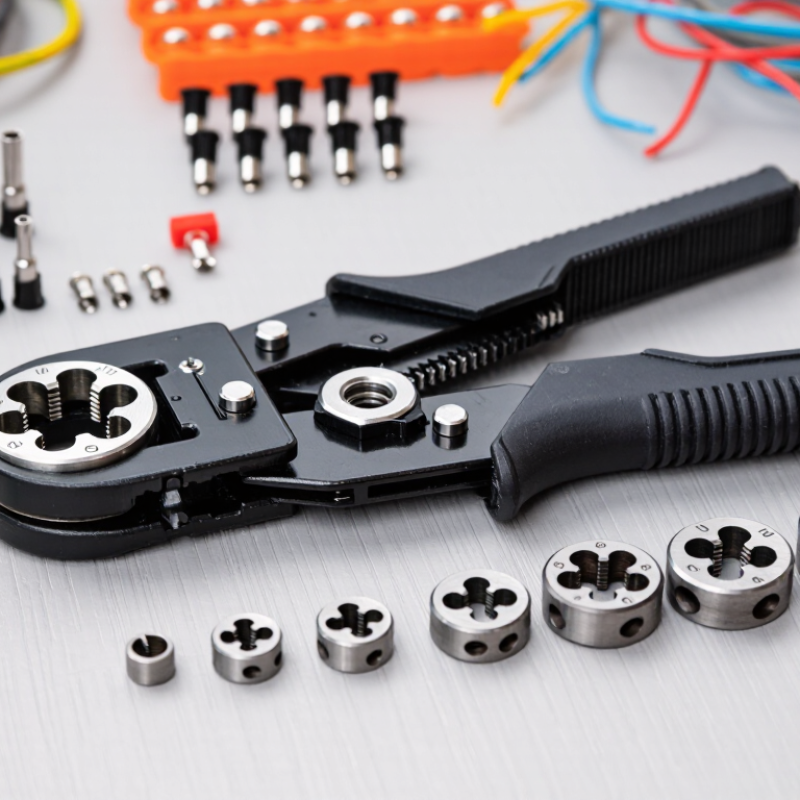
A hand crimper is a manually operated tool that compresses a terminal onto a wire. Its jaws apply controlled pressure around the connector barrel. This creates a mechanical and electrical connection without solder. Common versions serve insulated terminals, non-insulated terminals, coaxial connectors, and small wire ferrules. They appear in control panels, vehicle wiring, appliance repair, solar installations, and maintenance workshops.
The tool matters because poor compression can produce heat, voltage drop, or a loose conductor. A 2024 analysis by Grand View Research estimated the global hand tools market at approximately USD 23 billion in 2023. Crimpers represent a specialized segment, but their use follows the wider growth of electrical installation and repair work. IEC 60352-2 also emphasizes controlled crimping conditions for solderless connections, including suitable terminals, conductors, and tooling. The report does not prove every low-cost tool performs equally. That distinction matters.
In practice, technicians select a crimper by wire size, terminal type, and required compression profile. They should inspect the finished connection for firm retention, even deformation, and exposed strands. A pull test is useful. It is not perfect. Many field failures begin with the wrong die, not the wrong hand strength. I have also seen operators trust a clean-looking crimp without checking conductor movement. Manufacturer instructions and calibrated samples remain important when suppliers compare hand crimpers for professional use.
How to Evaluate Chinese Hand Crimper Manufacturers and Suppliers
China Top 10 Hand Crimper Manufacturers and Suppliers
Evaluating Chinese hand crimper suppliers requires more than comparing prices. The broader hand tools market is expanding steadily. Grand View Research reported a projected 4.3% CAGR from 2024 to 2030. This growth increases supplier competition, but not every factory offers equal control. Ask for die material, hardness results, crimp-force testing, and production traceability. A reliable manufacturer should explain its process clearly. Vague answers deserve caution.
Request samples from at least three suppliers. Test terminal fit, handle comfort, jaw alignment, and repeated crimp consistency. For electrical applications, compare results with IEC 60352-2 requirements and the workmanship guidance of IPC/WHMA-A-620. These standards support professional evaluation, but they do not replace independent testing. ISO 9001 certification is useful evidence of process management. It is not proof of excellent crimpers. A polished catalog can still hide weak dies.
Tips: Check whether calibration records include dates, instruments, and responsible technicians. Ask for a factory video, but prefer an on-site audit when volumes justify it. Confirm steel grade, coating thickness, packaging, lead time, spare parts, and warranty terms. Pull-force data should identify the wire size and terminal type. Otherwise, the number means little. I would also order a small trial batch. My first supplier choice may be wrong; real samples often expose assumptions that documents conceal.
China Top 10 Hand Crimper Manufacturers and Suppliers - How to Evaluate Chinese Hand Crimper Manufacturers and Suppliers
Anonymous supplier evaluation matrix based on commonly disclosed manufacturing, quality, customization, and export criteria
| Rank | Anonymous Supplier Profile | Operating Experience | Main Hand Crimper Type | Typical Crimping Range | Production Capability | Quality System | Customization Support | Typical MOQ | Sample Lead Time | Bulk Lead Time | Evaluation Score |
| 1 | Supplier Profile 01 | 15+ years | Ratchet terminal crimper | 0.25–6.0 mm² | High-volume assembly | ISO 9001 claimed | Private label, packaging, dies | 100–500 pcs | 7–15 days | 30–45 days | 92/100 |
| 2 | Supplier Profile 02 | 12+ years | Modular interchangeable-die crimper | 0.5–16 mm² | Medium-to-high volume | Documented inspection plan | Die profile and handle changes | 100–300 pcs | 10–18 days | 35–50 days | 89/100 |
| 3 | Supplier Profile 03 | 10+ years | Insulated terminal crimper | 0.5–6.0 mm² | Standard batch production | Incoming and final inspection | Color coding and packaging | 200–500 pcs | 10–20 days | 35–55 days | 86/100 |
| 4 | Supplier Profile 04 | 10+ years | Open-barrel terminal crimper | 0.5–5.5 mm² | Medium-volume production | Process inspection available | Terminal-specific die design | 100–300 pcs | 12–20 days | 40–55 days | 84/100 |
| 5 | Supplier Profile 05 | 8+ years | Ferrule crimper | 0.25–10.0 mm² | Small-to-medium batches | Basic quality documentation | Handle color and package design | 100–500 pcs | 7–15 days | 30–50 days | 82/100 |
| 6 | Supplier Profile 06 | 8+ years | Coaxial cable crimper | RG-type cable sizes | Specialized small batches | Dimensional inspection | Custom die cavities | 50–200 pcs | 15–25 days | 40–60 days | 79/100 |
| 7 | Supplier Profile 07 | 7+ years | Battery cable crimper | 10–120 mm² | Manual heavy-duty production | Load and visual checks | Jaw geometry and handle length | 50–200 pcs | 15–25 days | 45–65 days | 77/100 |
| 8 | Supplier Profile 08 | 6+ years | Solar cable crimper | 2.5–10.0 mm² | Standard and custom batches | Sample approval inspection | Cable-specific die sets | 100–300 pcs | 12–22 days | 35–55 days | 75/100 |
| 9 | Supplier Profile 09 | 5+ years | Multi-purpose wire crimper | 0.25–6.0 mm² | Small-to-medium batches | Basic final inspection | Logo-free packaging and color | 100–500 pcs | 10–20 days | 40–60 days | 72/100 |
| 10 | Supplier Profile 10 | 5+ years | Entry-level terminal crimper | 0.5–6.0 mm² | Low-to-medium volume | Batch sampling inspection | Limited die and packaging options | 200–500 pcs | 15–25 days | 45–65 days | 69/100 |
Evaluation note: Cable cross-section ranges, minimum order quantities, lead times, quality certifications, and customization capabilities vary by model and order volume. Buyers should verify current specifications, test samples, inspection records, warranty terms, and compliance documents directly before placing an order.
How to Compare Product Quality, Pricing, and Customization Options
When comparing hand crimper manufacturers and suppliers, begin with measurable quality, not catalog photos. Grand View Research estimates the global hand tools market will grow at about 4% annually through 2030, increasing pressure on suppliers to prove consistency. Request jaw hardness, material certificates, dimensional tolerances, and crimp-cycle test results. A reliable supplier should explain how samples are inspected and how failed units are handled. Check the crimp profile under magnification. Uneven compression often predicts loose terminals and rework.
Pricing needs a wider calculation. Compare the quoted unit price with tooling fees, minimum order quantity, packaging, freight, inspection, and replacement costs. A low offer can become expensive after repeated rejects. Ask for pull-force data based on the relevant IEC 60352-2 testing principles. The standard emphasizes mechanical strength and electrical reliability in crimped connections. It does not replace your application test.
Customization should be tested carefully. Confirm handle length, jaw geometry, wire range, surface treatment, markings, and packaging. Suppliers may offer custom tooling, but design changes can increase lead time and maintenance costs. Deloitte’s manufacturing research continues to identify flexible production as a competitiveness factor, yet flexibility is not free. Request a prototype before approving volume production. Measure five samples, not one. I would also record cycle fatigue after repeated use; this step is easy to overlook. A supplier that shares clear data, accepts reasonable corrections, and documents revisions usually deserves more trust than one offering only the lowest price.
How to Choose the Right Chinese Hand Crimper Supplier
How to Choose the Right Chinese Hand Crimper Supplier
China’s hand crimper market includes many capable factories, but product quality can vary sharply. A 2023 Grand View Research assessment valued the global hand-tools market at approximately USD 21 billion, with steady growth expected through 2030. This expansion attracts new suppliers, including inexperienced ones. A low quotation is not proof of efficiency.
Ask each shortlisted supplier for measurable evidence. Request material certificates, hardness records, crimp-height tolerances, and batch inspection reports. For electrical crimpers, confirm testing against relevant requirements in IEC 60352-2. For general tools, review dimensional control and load testing. Factory audits should check heat-treatment equipment, calibration records, and operator training. I would also order samples from three production batches. One sample can look perfect.
Supplier reliability needs wider evidence. Check export history through verified trade records, audit reports, and customer references from comparable industries. The ISO Survey 2023 recorded more than one million ISO 9001 certificates worldwide, but certification alone cannot guarantee consistent crimp force. Ask how nonconforming tools are isolated and corrected. Study the warranty process, spare-part availability, packaging strength, and response time. Some suppliers provide excellent samples but weaken inspection after the order grows. That risk deserves attention. A written quality agreement, pre-shipment inspection, and clearly defined acceptance limits can reduce unpleasant surprises. My own preference is a supplier that explains limitations openly, even when its price is not the lowest.
China Hand Crimper Supplier Selection Guide
The chart compares representative maximum conductor capacities for common hand-crimper categories. These values reflect typical market specifications rather than data from any individual company or brand. When choosing a Chinese supplier, verify the required wire range, terminal compatibility, crimp consistency, tooling material, quality control, and sample performance.