How to Choose the Right Drainage Pump for Your Needs

Choosing the right drainage pump begins with understanding the water, space, and work conditions involved. A flooded basement, construction trench, rainwater tank, and commercial wash area may all require different solutions. Water depth matters. So does the distance it must travel and the height it must reach. That vertical distance is called head, and ignoring it can cause weak performance.

A reliable drainage pump should match the required flow rate, pipe size, solids content, and power supply. Clear water may suit a compact submersible model, while muddy water needs a wider passage and stronger impeller. Check the manufacturer’s rated capacity under real head conditions, not only the largest number printed on the box. It is easy to overestimate performance. I have seen users choose a pump by horsepower alone, then struggle with blocked hoses and slow discharge. That assumption needs reconsideration.

Look closely at the installation area. A narrow pit may need a slim pump with an automatic float switch. A remote site may require a longer cable, protective controls, or a dependable generator connection. Corrosive water can damage ordinary metals, so material selection deserves attention. Safety remains essential. Use proper grounding, inspect cables, and follow local electrical requirements. When conditions are uncertain, consult a qualified technician and the pump manufacturer’s guidance.

The best choice is rarely the largest pump. It is the pump that works steadily, safely, and economically for the actual task. Compare specifications carefully, allow a practical margin, and plan for maintenance before water rises.
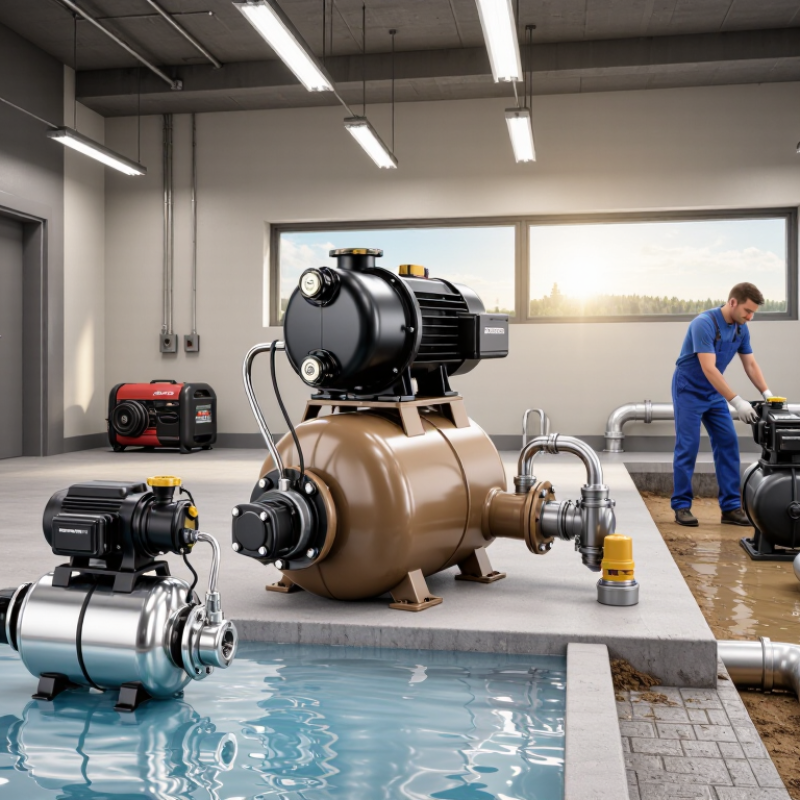
How to Choose the Right Drainage Pump for Your Needs

Define Your Drainage Pumping Requirements

Choosing a drainage pump starts with defining the water problem, not browsing pump catalogs.

Measure the catchment area, drainage level, pipe length, and discharge point. Record the lowest inlet elevation and the highest outlet elevation. Their difference is static head.

Estimate inflow from local rainfall data, groundwater seepage, or equipment washdown. NOAA Atlas 14 provides precipitation-frequency estimates for different durations and annual exceedance probabilities.

A basement may need design checks against a 1% annual-exceedance-probability storm, while a temporary work area may require another standard. Do not treat “100-year rainfall” as a calendar promise. It describes probability, not timing.

The U.S. Department of Energy reports that pumping systems can represent roughly 25% of industrial electricity use, so oversizing can waste energy and increase cycling. Yet my early calculations often ignored short, intense rainfall. That was a costly assumption.

Tips: Write down the required flow rate, total dynamic head, solids size, operating hours, and backup needs.

Add friction losses from elbows, valves, and long pipes. Select materials for the water’s temperature and chemical content.

Test the real discharge route, because a pump that performs well on paper may struggle through a narrow hose.

Leave sensible capacity, but avoid excessive oversizing.

A neat spreadsheet can still be wrong. Recheck it against site measurements and the most credible local data.

Compare Pump Types and Their Operating Principles

How to Choose the Right Drainage Pump for Your Needs

Compare Pump Types and Their Operating Principles

A drainage pump should match the water, not just the pipe size. Submersible centrifugal pumps use a rotating impeller to convert motor energy into water velocity and pressure. They suit clear or lightly contaminated water, especially in flooded basements and sumps. Trash pumps use wider passages and larger impellers. They handle leaves, mud, and small stones with less clogging. However, their open design may reduce pressure at greater lifting heights.

Diaphragm pumps work differently. A flexible diaphragm moves back and forth, creating suction and discharge through check valves. This positive-displacement principle handles sludge and air better, but flow is usually slower. The U.S. Department of Energy identifies pumping systems as a major industrial electricity load, often representing about 25% of industrial motor energy. Efficiency matters. I once selected a pump by peak flow alone, and the high discharge head made it underperform. That was a useful mistake.

Check total dynamic head, not vertical height alone. Include pipe friction, bends, valves, and the required outlet pressure. The Hydraulic Institute recommends evaluating duty point, efficiency, solids content, and operating conditions together. For frequent operation, choose a motor near its best-efficiency point. For occasional emergency drainage, portability and automatic level control may matter more. Measure twice. Tiny errors become costly.

Match Pump Capacity to Flow Rate and Head

Choosing a drainage pump starts with two numbers: required flow rate and total dynamic head. Flow rate measures how quickly water must leave the area. Head measures the resistance the pump must overcome, including vertical lift, pipe friction, valves, and discharge pressure.

The U.S. Department of Energy reports that pumping systems can represent about 20% of industrial electricity use. Oversizing therefore wastes energy, while undersizing leaves water standing. Measure the actual inflow during heavy rain, then add a modest operating margin. For example, 180 litres per minute at 6 metres of head requires a pump curve that delivers both values together. A headline flow number alone is misleading. Very misleading.

The Hydraulic Institute recommends evaluating pumps against system curves rather than relying only on catalogue capacity. Check the curve at your working point, not at zero head. A 7-metre lift may become 10 metres after narrow pipes, bends, and a dirty screen are included. I once underestimated friction because the pipe looked short; the pump ran, but drainage was painfully slow. That mistake is easy to repeat. The U.S. Environmental Protection Agency notes that water and wastewater facilities can use 30–40% of municipal energy, making efficient hydraulic matching worthwhile. Recheck the calculation after installation, because real conditions rarely match the drawing perfectly.

Evaluate Power Supply, Materials, and Installation Conditions

Choosing the right drainage pump starts with the available power supply. Check the voltage, frequency, circuit capacity, and distance from the outlet. A pump can meet the flow requirement yet perform poorly on an overloaded circuit. Confirm the starting current, especially when several appliances share one breaker. Outdoor installations also need suitable protection from moisture and accidental contact. When uncertain, ask a qualified electrician to verify the connection.

Materials should match the water conditions. Stainless steel and corrosion-resistant components suit damp areas, while reinforced plastics may work well with lighter residential drainage. Inspect the water for sand, debris, chemicals, or oily residue before selecting a pump. These details affect seal life and impeller wear. I once underestimated fine sediment on a small site; the pump ran, but cleaning became frequent and frustrating. The lesson is simple: clear water is not always clean water.

Tips

Measure the pit before ordering. Leave enough room for the float switch to move freely. Check the discharge pipe diameter and total lift, including bends. A narrow or sharply bent pipe can reduce real-world flow. Secure the pump on a stable base, not directly in loose sludge. Test the system after installation, then inspect it again after heavy rainfall. Small oversights matter.

Check Maintenance Needs, Safety Features, and Total Cost

How to Choose the Right Drainage Pump for Your Needs

A drainage pump should match the water, space, and workload around it. Measure the pit depth, discharge distance, and expected flow before buying. A pump that works in a shallow basement may struggle in a muddy construction trench. Check the manufacturer’s flow curve, not only the largest advertised capacity. Real performance drops when hoses rise, bend, or narrow.

Maintenance often decides whether a pump saves money. Choose accessible filters, replaceable seals, and a float switch you can test easily. Remove grit after each heavy use. Inspect the power cable, housing, and connections for cuts or corrosion. Safety matters just as much. Use ground-fault protection where required, keep plugs above standing water, and never lift a running pump by its cable. Automatic shutoff can prevent dry running, but it cannot replace supervision. I once treated “maintenance-free” as literal advice. That was a poor assumption.

Tips: Compare purchase price, electricity use, service parts, and expected working life. A cheaper unit may cost more after repeated seal failures. Keep a simple inspection log with dates, unusual noise, and repair details. Choose certified electrical protection and follow local installation rules. If the pump vibrates, smells hot, or loses flow, stop using it. Small warning signs rarely improve by themselves.

How to Choose the Right Drainage Pump for Your Needs - Check Maintenance Needs, Safety Features, and Total Cost

Pump Type Best-Suited Application Typical Flow Rate Typical Maximum Head Maintenance Needs Recommended Safety Features Typical Purchase Cost Estimated Annual Maintenance Estimated 5-Year Cost*
Light-Duty Submersible Utility Pump Basements, shallow pits, rainwater, and occasional household drainage 1,500–3,000 gal/h
(5.7–11.4 m³/h)
20–30 ft
(6–9 m)
Rinse after use, inspect the inlet screen, and check the power cord and float switch before storage. Ground-fault protection, thermal overload protection, corrosion-resistant housing, and a screened inlet. $120–$250 $25–$50 $245–$500
Heavy-Duty Submersible Dewatering Pump Construction sites, flooded rooms, drainage sumps, and frequent water removal 3,000–8,000 gal/h
(11.4–30.3 m³/h)
25–45 ft
(7.6–13.7 m)
Clean the strainer regularly, inspect seals and bearings, and verify that the discharge hose is not restricted. Thermal overload protection, low-water shutoff, lifting handle, grounded plug, and a robust intake guard. $300–$650 $60–$120 $600–$1,250
Effluent or Wastewater Pump Septic effluent, graywater, drainage chambers, and liquids containing small soft solids 3,000–7,000 gal/h
(11.4–26.5 m³/h)
20–40 ft
(6–12.2 m)
Inspect the float mechanism, clean the pump chamber, check seals, and follow the scheduled service interval. Sealed motor housing, automatic float control, overload protection, backflow prevention, and an accessible disconnect. $400–$850 $80–$160 $800–$1,650
High-Head Drainage Pump Long discharge runs, elevated outlets, deep pits, and locations requiring higher pressure 1,500–4,500 gal/h
(5.7–17 m³/h)
40–80 ft
(12.2–24.4 m)
Check impeller wear, inspect seals, remove sediment, and confirm that the pump is operating within its rated head. Thermal protection, pressure-rated discharge fittings, dry-run protection, and a lockable electrical isolator. $450–$950 $90–$180 $900–$1,850
Solids-Handling or Grinder Pump Wastewater containing solids where clog resistance and pressure for long discharge lines are important 2,000–5,000 gal/h
(7.6–18.9 m³/h)
50–120 ft
(15.2–36.6 m)
Inspect the cutter or impeller, check for blockage, test the control system, and arrange periodic professional servicing. Motor overload protection, sealed electrical components, non-return valve, alarm circuit, and a lockable disconnect. $750–$1,500 $150–$300 $1,500–$3,000
Engine-Driven Trash Pump Outdoor sites without dependable electrical power and water containing dirt or larger debris 8,000–20,000 gal/h
(30.3–75.7 m³/h)
75–100 ft
(22.9–30.5 m)
Change engine oil as specified, clean the air filter, inspect hoses, drain fuel for storage, and service the pump casing. Outdoor-rated fuel system, exhaust ventilation, emergency stop, guarded hot surfaces, and stable operating support. $600–$1,300 $180–$400 $1,500–$3,300
*Cost assumptions: Indicative USD ranges for new equipment before tax, installation, hoses, controls, fuel, electricity, and emergency repairs. The estimated 5-year cost equals the purchase cost plus five years of routine maintenance; actual costs vary with duty cycle, water quality, operating head, labor rates, and local market conditions.
×

Cart