
7 Inline Pump Buying Tips for Global Buyers
Choosing an inline pump for an international project involves more than matching pipe size and price. The pump must suit the actual flow, pressure, fluid, and installation conditions. A model that looks right on a product page may perform poorly if its duty point is misunderstood. Small mismatches matter. Especially at startup.
This guide outlines seven practical checks for global buyers, from reviewing pump curves to confirming materials, motor details, and supplier support. Compare the required operating point with the manufacturer’s published curve, not just the pump’s maximum flow or head. Check the duty point. Then verify fluid temperature, viscosity, and any solids that may affect performance. Ask for clear documentation, including dimensions, connection details, and applicable test information. A datasheet helps, but it cannot answer every question.
Purchasing across borders adds real-world details. Confirm voltage and frequency, packaging, lead time, spare-parts availability, and who will assist if commissioning raises questions. Get specifications and commercial terms in writing. Do not assume that similar-looking models are interchangeable. Actual site conditions can surprise even careful teams. No checklist removes every uncertainty, and supplier claims still need review against project requirements. A lower price may be reasonable, or it may leave out important details. The following tips help buyers ask better questions, compare offers fairly, and choose an inline pump with greater confidence.
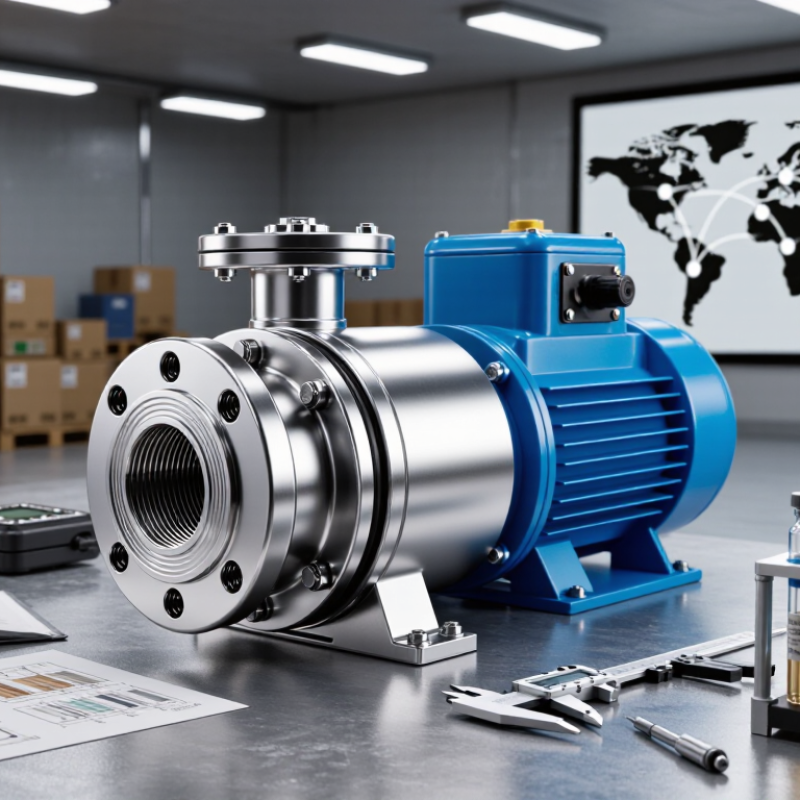
Identify the Inline Pump Type and Its Intended Application
Before comparing quotations, define the pump’s duty and operating environment. The U.S. Department of Energy’s Improving Pumping System Performance sourcebook reports that pumping systems consume nearly 20% of global electricity demand and 25–50% of energy in some industrial operations. Correct application matching can therefore affect both reliability and operating costs.
For clean water in a closed-loop heating or cooling circuit, an inline centrifugal pump may be appropriate. Higher pressure requirements may call for a multistage design, but check the pump curve against the actual flow and head. Also record fluid temperature, viscosity, solids content, pipe size, and available installation space. Small details matter. A pump selected only by connection size can miss the duty point, run inefficiently, or struggle with the fluid. This is easy to overlook.
Tip: Describe the application in one line, such as “cooling-water circulation, 12 m³/h, 18 m head, 40°C.” Then confirm the operating point with the supplier using the system curve. Ask whether the quoted pump suits continuous operation and the expected fluid conditions. A neat catalog match can still be wrong. When site measurements are incomplete, state the uncertainty rather than treating an estimate as a confirmed requirement.
7 Inline Pump Buying Tips for Global Buyers - Identify the Inline Pump Type and Its Intended Application
Compare common inline pump configurations with the fluids and duties they are generally suited to. Actual performance depends on the model, materials, operating conditions, and manufacturer’s published curve.
| Inline Pump Type | Typical Configuration | Common Applications | Key Selection Checks | Buying Tip |
|---|---|---|---|---|
| Close-coupled single-stage centrifugal | Pump and motor share a compact, directly coupled assembly; suction and discharge connections are usually in line. | Building water circulation, HVAC loops, and general water transfer. | Required flow and head, motor supply, liquid temperature, seal material, and available installation space. | Confirm that the duty point falls within the pump’s recommended operating range, rather than selecting by connection size alone. |
| Long-coupled single-stage centrifugal | Pump and motor are separately supported and connected by a coupling, allowing access to the rotating assembly in many designs. | Commercial and industrial water systems where maintenance access or heavier-duty construction is important. | Baseplate or support requirements, alignment procedure, service clearance, shaft seal, and operating speed. | Check the installation drawing and maintenance clearances before ordering, especially when replacing an existing pump. |
| Vertical multistage inline | Several impellers are arranged vertically to build pressure while keeping the suction and discharge connections in line. | Pressure boosting, water treatment systems, and circulation duties requiring higher head from a compact footprint. | Number of stages, pressure rating, minimum inlet pressure, water quality, and allowable operating temperature. | Verify inlet conditions and the required pressure at the actual flow rate; a multistage design does not remove the need for adequate suction pressure. |
| In-line circulation pump | Designed for installation directly in a closed-loop or distribution pipeline; may use different rotor and motor arrangements. | Hot-water heating, chilled-water circulation, and hydronic building systems. | Fluid temperature, system pressure, flow range, control method, and compatibility with water-glycol mixtures if used. | Check whether the pump is suitable for continuous circulation and whether the controls match the system’s operating strategy. |
| Variable-speed inline pump | Includes or supports a variable-frequency drive to adjust motor speed in response to demand or a control signal. | HVAC systems with changing loads, pressure-controlled distribution, and energy-conscious circulation duties. | Supply voltage and frequency, control inputs, minimum and maximum speed, ambient conditions, and electromagnetic compatibility requirements. | Confirm drive compatibility with the site’s electrical supply and control system, and review any requirements for motor cooling or cable installation. |
| Stainless-steel inline centrifugal | Wetted pump components use a stainless-steel grade selected for the intended liquid and service conditions. | Clean-water duties, some process-water services, and applications where corrosion resistance is required. | Exact stainless-steel grade, chloride concentration, temperature, cleaning chemicals, and seal elastomer compatibility. | Do not treat all stainless steel as interchangeable; verify material compatibility against the liquid composition and operating conditions. |
| Close-coupled inline pump with electronic controls | Compact pump assembly with integrated sensors, display, or control functions that may support constant-pressure or proportional-pressure operation. | Building services and packaged systems where local adjustment or system feedback is useful. | Available control modes, sensor location, communication interfaces, protection ratings, and commissioning requirements. | Ask which functions are included as standard and which require external sensors, accessories, or system configuration. |
Related Posts
-
Understanding the Fundamentals of Inline Pumps for Efficient Fluid Management
-

2026 Best Inline Pump Types for Global Buyers?
-
What are the Best Inline Pumps for Global Procurement?
-

10 Essential Tips for Choosing the Right Inline Pump for Your Needs?
-

Top 10 Electric Water Pumps for Efficient Water Transfer?
-
Why You Should Choose the Right Water Pump Motor for Your Needs
