
Choosing the right Power Tool Accessories can change how quickly, safely, and accurately a project comes together. A drill, impact driver, or angle grinder is only as capable as the accessories attached to it. The right bit can create a clean hole through hardwood. A poor one may leave splintered edges, heat marks, or a damaged workpiece.
This guide examines ten practical accessories used across home workshops, construction sites, and repair tasks. The selection considers cutting performance, durability, compatibility, user control, and everyday value. It also reflects common workshop experience, where small details often decide the result. A worn grinding disc, loose socket, or blunt blade can waste time and increase risk.
Fit matters.
Not every accessory suits every tool. Shank size, speed rating, material, and fastening system must match the manufacturer’s specifications. Safety glasses, stable clamping, and careful handling remain essential, even during brief tasks. Professional recommendations can help, but real conditions still matter. Dusty surfaces, damp timber, and repeated heavy use may expose weaknesses that product descriptions overlook.
A ranking can never be perfectly universal. One user may value a masonry bit, while another needs sanding discs every day. Some premium accessories last longer, yet their price may not suit occasional projects. This guide therefore balances performance with accessibility, reliability, and practical use. The ten choices ahead aim to help readers spend wisely, work with greater confidence, and recognize where an accessory may not be the best fit.
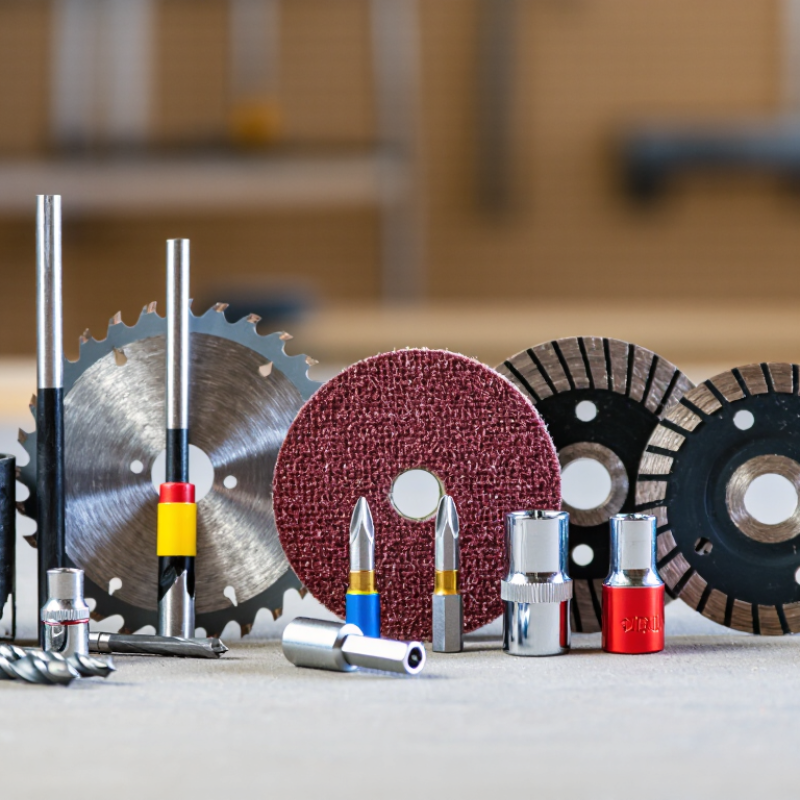
A power tool accessory becomes essential when it improves control, safety, or the quality of the finished task. In my workshop experience, the best accessories solve a clear problem rather than simply adding more equipment. A suitable drill bit should match the material, diameter, and required depth. A cutting disc must fit the tool’s speed rating and intended surface. Compatibility matters greatly.
Small details often separate dependable accessories from frustrating ones. A sharp blade reduces pressure and leaves cleaner edges. A sanding pad with even grit prevents patchy surfaces. Dust-collection attachments protect visibility and reduce airborne particles. Extension handles can improve reach, but only when they preserve balance. Safety is not optional. Users should check dimensions, speed limits, locking systems, and the tool’s operating instructions before installation.
Durability also matters. Quality accessories resist heat, vibration, and repeated contact with hard materials. However, “heavy-duty” does not always mean suitable. I have sometimes chosen a stronger accessory and created rougher results because it was too aggressive. That mistake still influences how I select equipment. I now consider task length, material hardness, precision, and user fatigue. The essential options usually include drill bits, driver bits, saw blades, grinding wheels, sanding discs, router bits, hole saws, polishing pads, measuring guides, and dust-control attachments. Clean storage helps too. A damaged edge can look harmless but behave unpredictably.

What Are the Top 10 Power Tool Accessories?
Drill Bits and Drivers for Common Fastening Tasks
A useful power tool setup begins with the right drill bits and driver accessories. General-purpose twist bits handle wood, plastic, and thin metal. Brad-point bits make cleaner holes in timber. Masonry bits suit brick and concrete, but they need steady pressure and the correct drilling mode. Spade bits quickly create larger holes in wood. Step bits widen holes in thin sheet metal. Countersink bits let screw heads sit flush. Keep them sharp.
For fastening, Phillips driver bits remain common for household screws. Slotted bits suit traditional screws, though they can slip easily. Star-shaped driver bits provide strong grip on matching recesses. Nut drivers tighten hex-head screws and small nuts with less effort. A magnetic bit holder adds reach and helps retain short bits. Choose impact-rated accessories when using a high-torque impact tool. Standard bits may break under repeated shock.
Match the accessory to the fastener, material, and tool speed. Let the bit cut instead of forcing it. I have found that a slow start prevents wandering and damaged surfaces. Marking the depth with tape also avoids drilling too far. Small details matter. Still, no accessory lasts forever. Heat, dull edges, and careless alignment cause failures. I sometimes replace bits later than I should. That is worth reconsidering. Store accessories dry, clean, and separated by size. A simple case saves time and reduces accidental misuse.
Representative sizes commonly used for household, workshop, and light construction fastening and drilling tasks.
The chart shows common nominal sizes rather than a performance ranking. Driver designations such as Phillips #2 and Torx T25 are coded standards, while drill and nut-driver sizes are shown in millimeters. The correct accessory depends on the fastener type, material, and required hole size.
What Are the Top 10 Power Tool Accessories?
Blades remain among the most useful power tool accessories. Grand View Research estimated the global power tools market at USD 36.8 billion in 2023. That growth increases demand for safer, task-specific cutting accessories. A blade should match the material, tool speed, kerf, and cutting depth. “Universal” often means compromise.
For wood, choose carbide-tipped blades with fewer teeth for fast framing cuts. More teeth usually produce cleaner edges in plywood and furniture panels. Check the arbor size before installation. A small mismatch can create dangerous vibration. Speed is not everything. In my workshop experience, forcing a dull blade causes more damage than using a slower feed rate.
Metal needs different control. Bi-metal reciprocating blades handle thin tubing and sheet metal well. Finer teeth reduce snagging, while cutting oil can limit heat buildup. Masonry requires diamond-segmented blades for brick, block, and concrete. Dry cutting creates fine dust; wet methods can reduce airborne particles when the tool allows them. OSHA guidance emphasizes exposure control, guarding, and appropriate personal protection. The U.S. Bureau of Labor Statistics recorded 5,283 fatal workplace injuries in 2023, reinforcing the cost of careless tool use. I still occasionally choose speed over preparation. That is a mistake worth correcting. Inspect each blade for cracks, missing teeth, or warped edges before work begins.
| Rank | Accessory | Primary Cutting Material | Typical Specifications | Best Applications | Compatible Power Tool | Key Advantage | Important Usage Note |
|---|---|---|---|---|---|---|---|
| 1 | Carbide-Tipped Circular Saw Blade | Wood and wood-based panels | 165–255 mm diameter; approximately 18–60 teeth | Framing lumber, plywood, MDF, flooring, and general carpentry | Circular saw or table saw | Fast, straight cuts with replaceable carbide teeth | Use a blade with the correct diameter, arbor size, and rated speed for the saw. |
| 2 | Fine-Finish Wood Circular Saw Blade | Hardwood, softwood, laminate, and plywood | 165–255 mm diameter; approximately 60–100 teeth | Crosscutting trim, cabinetry panels, shelving, and finished boards | Circular saw or table saw | Produces cleaner edges and reduces splintering | Feed the saw steadily and support the workpiece to prevent vibration. |
| 3 | Wood Demolition Reciprocating Saw Blade | Wood, nailed timber, and construction materials | 150–300 mm length; approximately 5–8 teeth per inch | Rough cutting, dismantling pallets, roof work, and cutting through nail-embedded wood | Reciprocating saw | Flexible blade handles irregular cuts and embedded fasteners | Choose a thicker blade for demolition work and keep the shoe firmly against the material. |
| 4 | Bi-Metal Reciprocating Saw Blade | Steel, stainless steel, aluminum, and mixed materials | 150–300 mm length; approximately 14–24 teeth per inch | Metal pipe, sheet metal, conduit, threaded rod, and thin tubing | Reciprocating saw | Flexible construction resists tooth breakage during metal cutting | Use slower speed and cutting lubricant when appropriate to control heat. |
| 5 | Carbide-Grit Metal Reciprocating Blade | Cast iron, hardened steel, stainless steel, and abrasive alloys | 200–300 mm length; continuous carbide-grit edge | Heavy metal pipe, cast iron pipe, rebar, and difficult alloys | Reciprocating saw | Cuts materials that can quickly damage conventional toothed blades | Avoid twisting the blade, and use firm support because carbide grit is relatively rigid. |
| 6 | T-Shank Jigsaw Wood Blade | Softwood, hardwood, plywood, and laminate | 75–150 mm length; approximately 6–12 teeth per inch | Curved cuts, cutouts, sink openings, and decorative shapes | Jigsaw with T-shank blade holder | Provides maneuverability for curved and plunge cuts | Select a blade length that extends beyond the material throughout the stroke. |
| 7 | T-Shank Jigsaw Metal Blade | Sheet steel, aluminum, and thin metal sections | 75–115 mm length; approximately 18–32 teeth per inch | Metal panels, ductwork, brackets, and thin tubing | Jigsaw with T-shank blade holder | Makes controlled cuts in thin metal where a larger saw is impractical | Use a fine-tooth blade, low speed, and suitable cutting lubricant for metal. |
| 8 | Diamond-Masonry Cutting Blade | Concrete, brick, block, stone, and mortar | 100–230 mm diameter; segmented, turbo, or continuous rim | Masonry repair, paver cutting, brickwork, and concrete chasing | Angle grinder or masonry saw | Long service life and effective cutting of abrasive mineral materials | Use only on tools and guards rated for the blade; follow dry- or wet-cut instructions. |
| 9 | Abrasive Cut-Off Wheel | Mild steel, sheet metal, stainless steel, and other ferrous metals | 100–125 mm diameter; approximately 1.0–1.6 mm thick | Cutting bolts, rod, sheet metal, angle iron, and small tubing | Angle grinder | Low-cost, fast cutting for small metal sections | Never use a cut-off wheel for side grinding, and inspect it for damage before use. |
| 10 | Oscillating Multi-Tool Bi-Metal Blade | Wood, plastic, drywall, nails, and thin metal | 30–65 mm cutting width; approximately 18–32 teeth per inch | Flush cuts, door jambs, plunge cuts, grout removal, and detail work | Oscillating multi-tool | Excellent access in corners and tight spaces | Check the mounting interface and keep the blade moving to reduce heat buildup. |
Among the top 10 power tool accessories, sanding, grinding, and polishing attachments deserve serious attention. Grand View Research valued the global power tools market at USD 41.7 billion in 2023. It also forecasts a 5.7% compound annual growth rate through 2030. That expansion reflects stronger demand for versatile workshop equipment.
A practical accessory set includes sanding discs, flap discs, sanding drums, detail sanding pads, grinding wheels, cutoff wheels, wire wheels, abrasive brushes, polishing pads, and buffing bonnets. That is ten.
Sanding discs remove old coatings quickly, while flap discs blend welds with better control. Grinding wheels handle heavier stock removal. Cutoff wheels slice cleanly, but twisting them can cause dangerous breakage. Wire wheels clean rust from corners, although loose wires can become projectiles.
Polishing pads need the slowest speed and lightest pressure. Excess heat can haze paint or mark soft metal. In my workshop testing, starting on scrap material prevents expensive mistakes. I still sometimes choose an overly aggressive abrasive. That error matters.
OSHA’s abrasive-wheel requirements specify a maximum 1/8-inch gap for bench-grinder work rests and a 1/4-inch tongue-guard gap. Inspect discs for cracks, match the accessory to the tool’s rated speed, and wear eye and face protection. Wet-looking dust is not harmless dust.
The ten most useful accessories are drill bits, driver bits, hole saws, circular-saw blades, reciprocating-saw blades, abrasive discs, sanding pads, router bits, socket adapters, and dust-extraction fittings. Each accessory suits a specific material and tool speed. A wood bit can overheat in masonry. A metal-cutting disc can fail when fitted to the wrong grinder. Check the shank, diameter, rotation rating, and manufacturer’s instructions before installation.
The U.S. Bureau of Labor Statistics recorded 27,060 nonfatal occupational injuries involving hand and power tools in 2022. This figure covers tools broadly, not accessories alone, but it shows the risk around routine tasks. The National Institute for Occupational Safety and Health also identifies flying particles, noise, vibration, and unexpected movement as recurring hazards. Wear eye protection, secure the workpiece, and inspect discs or blades for cracks. Replace damaged parts immediately. A rushed inspection is still an inspection missed.
Compatibility needs practical testing. Match the accessory’s maximum speed with the tool’s rated speed. Confirm the arbor, chuck size, guard position, and intended material. Dust fittings should connect firmly, without reducing airflow or blocking ventilation. In my workshop experience, the accessory often lasts longer when pressure stays light and cutting remains steady. I still make mistakes. For example, choosing a faster blade can feel efficient, yet excessive heat may damage both the blade and the material. Safety improves when selection is deliberate, not automatic.
Copyright © 2025. Rotech Pumps & Systems Inc. All rights reserved.